
Many people think honey is healthier than table sugar because it feels more natural, less processed, and closer to food in its original state.
Marketing around honey, dates, coconut sugar, maple syrup, and other natural sweeteners often reinforces that idea by presenting them as cleaner or more nutritious alternatives to refined sugar.
Because of that, a common question comes up: Is honey meaningfully healthier than sugar, or does the body treat both sweeteners in mostly the same way?
Answering that question requires a balanced view. Honey does have a slight nutritional and functional edge over refined sugar because it contains trace bioactive compounds, antioxidants, enzymes, minerals, and phenolic compounds.
Biochemically, sugar is sugar in many important ways, but clinical research suggests it may offer more benefit when it replaces other sweeteners rather than simply being added on top of a normal diet.
What Sugar and Honey Are Made Of?
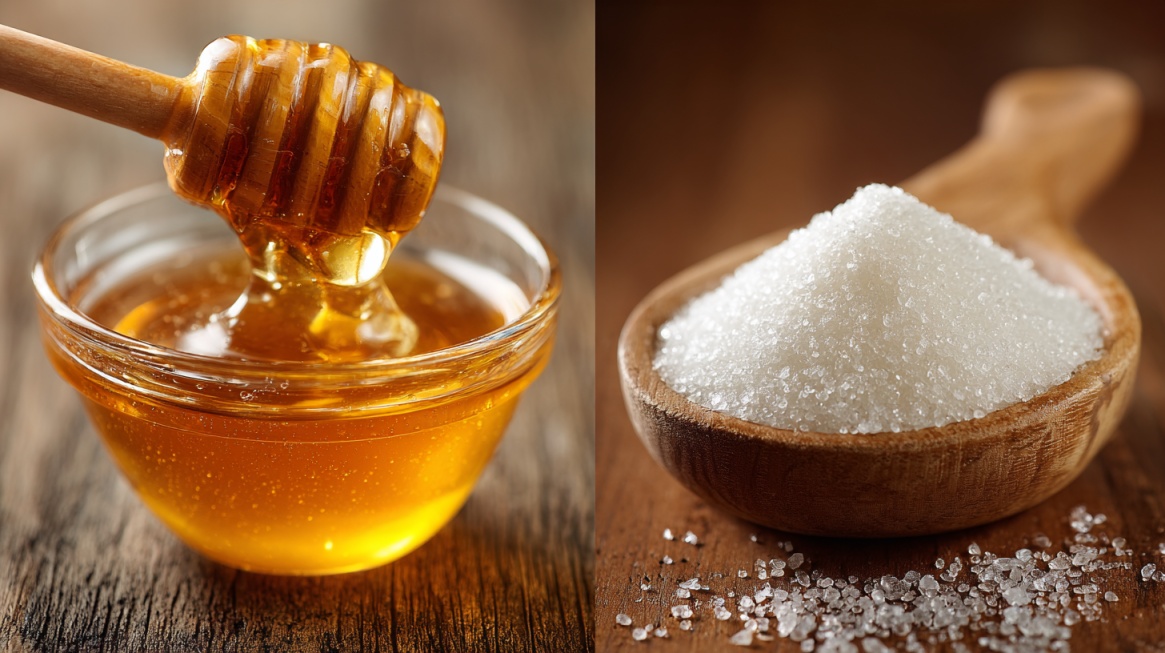
Table sugar, also called sucrose, is made of glucose and fructose in a one-to-one ratio. Put simply, sucrose is 50% glucose and 50% fructose.
It provides calories, but it does not provide meaningful amounts of minerals, vitamins, fiber, or other nutrients. For that reason, refined sugar is often described as empty calories.
Honey has a more complex makeup. It is mainly a mixture of sugars and water, along with small quantities of other compounds.
- 80% to 85% sugars
- 15% to 17% water
- 0.1% to 0.4% proteins
- Smaller amounts of enzymes, organic acids, vitamins, minerals, and phenolic compounds
Honey’s exact composition can change based on botanical source, geography, harvest timing, climate, storage, and processing. As a result, not all honey has the same color, flavor, antioxidant level, or nutrient profile.
Both ultimately deliver glucose and fructose to the body. It has more chemical complexity than refined sugar, but its dominant nutritional feature is still sugar.
Does Honey Save You Calories?
Honey is often seen as lighter or healthier, but calorie differences depend on how it is measured.
One teaspoon of granulated sugar has about 15 calories, while one teaspoon of honey has about 20 calories. By spoonful, honey can actually provide more calories.
Measured by weight, honey and sugar are also very close. Honey has nearly the same caloric density as table sugar, at about 300 to 320 kilocalories per 100 grams.
Sweetness changes the practical comparison. It may taste about twice as sweet as sucrose, so some people may use less of it to get a similar level of sweetness.
- A person uses a smaller amount of sugar to get a similar sweetness.
Replacing sugar with equal spoonfuls does not automatically reduce calories. Honey should not be treated as a low-calorie sweetener. It is still an energy-dense added sweetener.
Still, many people prefer using honey in homemade snacks like no-bake oat bars because it can add sweetness while also helping bind ingredients together naturally.

Glycemic Index and Blood Sugar Response
Glycemic index, or GI, measures how much carbohydrate-containing foods raise blood sugar.
- Low GI: 1 to 55
- Medium GI: 56 to 69
- High GI: 70 or higher
Table sugar has a GI of about 63 to 65. Honey can vary more, with reported GI values around 55 to 75. Manuka honey has been reported at an average GI of about 57.
Honey may have a slightly lower GI than table sugar in some cases, partly because some has a higher fructose ratio. Still, that difference is not large enough to make blood sugar neutral.
Portion size matters more than small GI differences. Individual metabolism also affects blood sugar response. Honey and table sugar can affect blood glucose and insulin in similar ways, especially when eaten in similar amounts.
For people with diabetes, prediabetes, insulin resistance, or blood sugar concerns, it should still be treated as an added sugar.
What is Honey’s Main Advantage

Honey’s main advantage over refined sugar is its trace nutrient and bioactive compound content.
It contains small amounts of enzymes, organic acids, vitamins, minerals, proteins, amino acids, and phenolic compounds.
- Proteins
- Enzymes
- Amino acids
- Minerals
- Trace elements
- Vitamins
- Polyphenols
- Pollen
Honey can also contain small amounts of minerals such as calcium, iron, and potassium. Refined sugar does not provide these kinds of compounds in meaningful amounts.
Antioxidants and phenolic compounds are a major part of its health reputation. Honey’s antioxidant, anti-inflammatory, antibacterial, and antiviral properties are largely linked to phenolic compounds.
Total phenolic content can vary widely across different honeys, with reported values ranging between 0.65 ± 0.42 and 84.17 ± 30.40 milligrams per 100 grams.
@doctorsood 🍯 Honey: Nature’s sweet superfood! 🌿 Not just delicious, but packed with antioxidants, fights inflammation, supports heart health, and even helps with wound healing. 🐝✨ Ready to make your health sweeter? Share your favorite way to use honey below! 👇💛 VC: @sammy k #honey #superfood #healthtips ♬ original sound – DoctorSood, M.D.
- Darker honeys may contain higher antioxidant levels.
- Buckwheat honey, for example, is darker, less sweet, and high in antioxidants.
- Manuka honey is often associated with antiviral, antibacterial, antioxidant, and anti-inflammatory properties.
Getting nutritionally meaningful amounts would require hundreds of grams per day, which would also mean excessive sugar intake.
Honey has a modest compositional advantage over refined sugar. Still, it should not be used as a primary source of vitamins, minerals, or antioxidants.
What Human Research Says About Honey’s Health Effects
Human research gives honey a more nuanced position than simple marketing claims do. A comprehensive review analyzed 48 clinical trials published between 1985 and 2022, involving 3,655 subjects.
Across those trials, honey showed more beneficial than negative or neutral effects on several outcomes.
- Cardiovascular and metabolic risk factors
- Glucose tolerance
- Treatment-related mucositis
- Cough in children
- Wound healing
Benefits appeared especially likely when honey replaced other sweeteners instead of being added to a diet that already contained usual sweetener intake. That point matters because adding honey on top of an already high-sugar diet increases total sugar exposure.
Limitations also matter. Available studies are still limited in number, and many are not standardized.
Differences in honey type, floral source, processing, dose, and participant health status can change results. Because of that, findings should be interpreted with caution.
Summary
Yes, slightly, but not enough to ignore moderation. Honey has a modest advantage because it contains trace nutrients, enzymes, minerals, antioxidants, and phenolic compounds that refined sugar lacks.
However, it is still mostly sugar. It still contributes calories, still affects blood glucose, and still counts as an added sugar or free sugar.